Coming soon
Inside the FAANG Hiring Black Box: What Really Gets You Hired
Abhijay Vuyyuru, Jugal Bhatt and Shreya Mehta join Open Atlas Summit 2026 to unpack resumes, networking, recruiter screens and what actually helps candidates break into Big Tech.
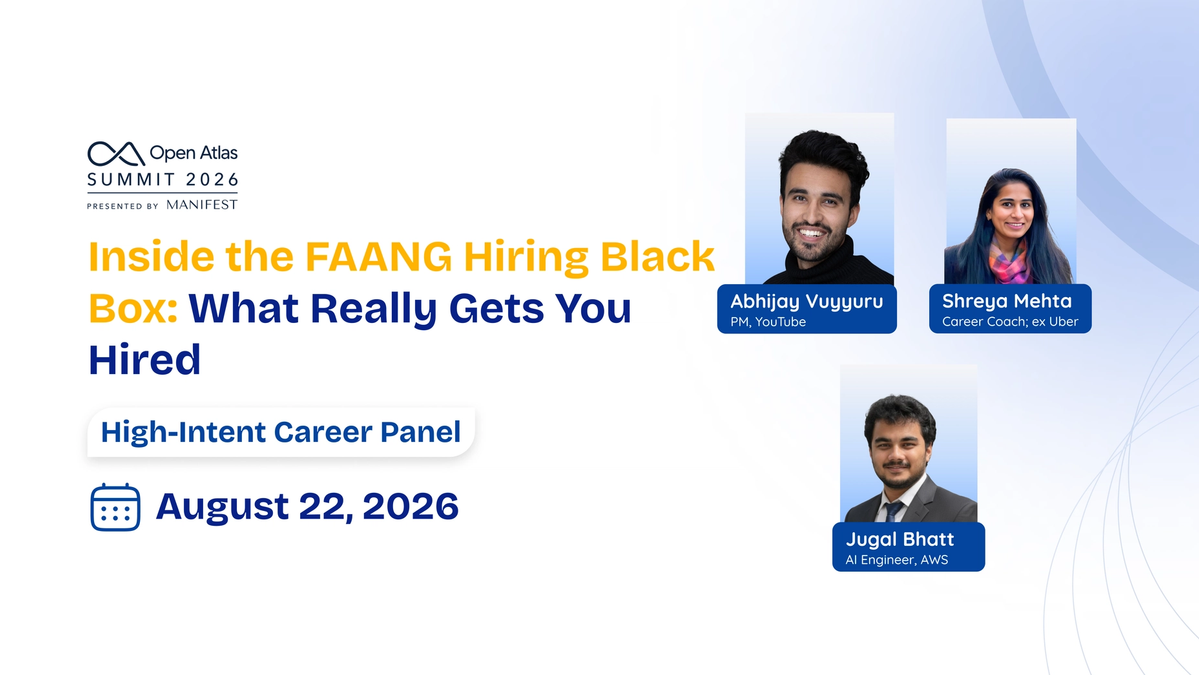
Why do strong candidates get ignored while others break into Big Tech? Open Atlas Summit 2026 will bring together Abhijay Vuyyuru, Jugal Bhatt and Shreya Mehta for a practical look inside the hiring process—from positioning and recruiter screens to networking, interviews and the signals that help candidates stand out.
Meet the Speakers
Abhijay Vuyyuru
AI Product Manager at YouTube within Google, bringing the perspective of a product professional working inside Big Tech.
Jugal Bhatt
Software Engineer at Amazon. His recent job-search story has highlighted targeted networking, recruiter outreach and visible proof of work rather than relying only on cold applications.
Shreya Mehta
Career coach and former recruiter with experience across global technology companies, including Uber; the Summit sheet lists “Shreya,” and this identity should be confirmed before publishing.
What This Session Is About
There is no single FAANG formula. Hiring varies by company, function, level and market conditions. But candidates can improve the quality of their search by understanding how recruiters and hiring teams reduce thousands of applications into a much smaller group worth interviewing.
What Will the Session Explore?
A resume needs a clear hiring signal
The strongest resumes make scope, ownership and measurable outcomes easy to understand. Generic task lists force recruiters to guess why a candidate is strong.
Targeted applications beat undirected volume
Jugal’s job-search experience illustrates the value of identifying relevant roles, tailoring the application and building relationships around a smaller target list instead of applying everywhere with the same materials.
Networking works when it creates context
A useful connection is not a random referral request. It gives a recruiter or employee enough information to understand the candidate’s fit and make a credible introduction.
Interviews test more than technical correctness
Big Tech hiring often evaluates problem solving, communication, judgment, collaboration and role-specific depth. Candidates need to show how they think, not simply reach an answer.
AI changes the baseline
As AI tools make basic output easier to produce, differentiated judgment, domain expertise, product sense and the ability to use AI responsibly can become stronger career signals.
Why This Session Matters
For international students and immigrant professionals, a better hiring strategy can save months of low-signal effort. This panel is about making the process less mysterious: understand what hiring teams need to see, create evidence of that value and build a job search around quality rather than desperation.
Important: Hiring processes and outcomes vary by company, role and market conditions. Participation does not guarantee employment.
Book your Summit tickets: https://luma.com/8c4qusfp